Best POS Systems for Boutiques and Fashion Retail 2025
Last Updated: December 2025 | Running a successful boutique requires more than great taste in fashion. Your POS system must handle complex inventory with size and color variants, provide personalized customer experiences, and seamlessly connect in-store and online sales. After extensive evaluation of POS systems specifically for boutique operations, we have identified the six best solutions that understand the unique demands of fashion retail.
Our Top Picks at a Glance
| POS System | Best For | Starting Price | Key Strength |
|---|---|---|---|
| Shopify POS | Best Overall | $39/month | Omnichannel excellence |
| Lightspeed Retail | Multi-Location | $89/month | Advanced inventory |
| Square for Retail | Single-Location | $0/month | Value and simplicity |
| Vend (Lightspeed X) | Inventory Management | $99/month | Fashion-specific features |
| Clover | In-Store Experience | $14.95/month | Professional hardware |
| Erply | Fashion-Specific | $19/month | Apparel specialization |
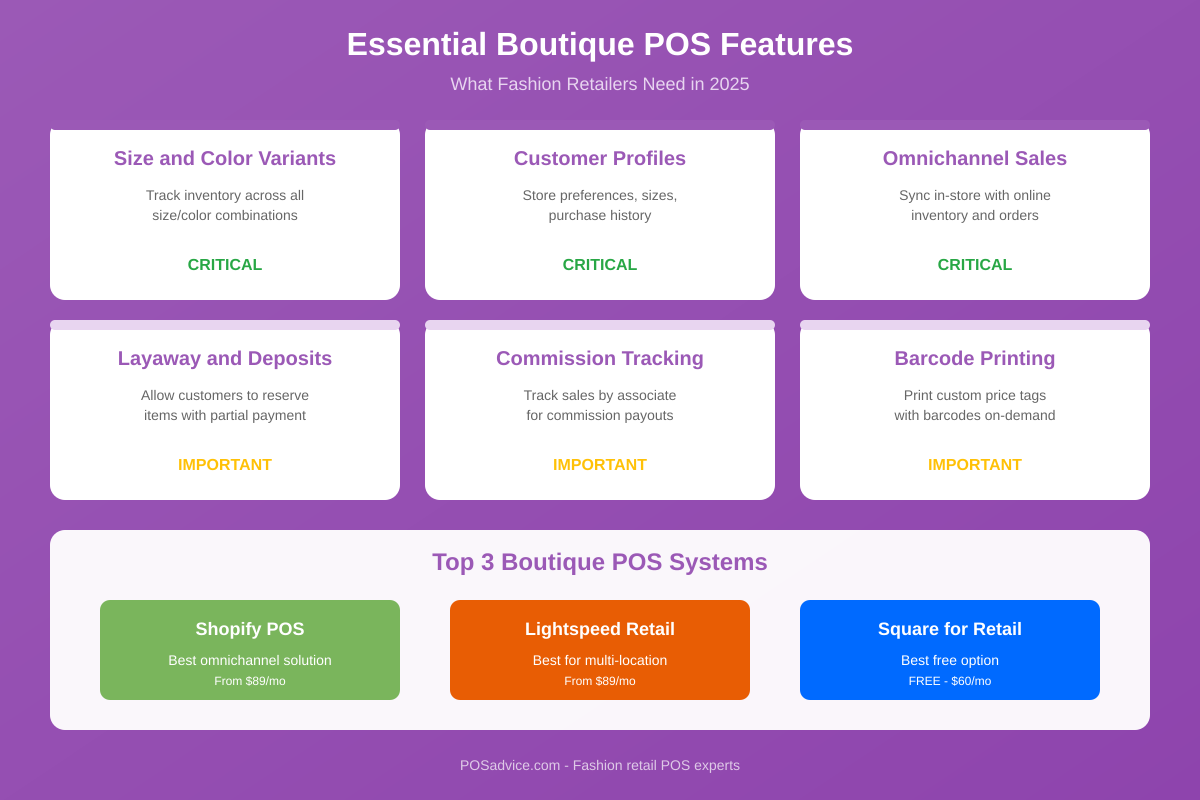
What Boutiques Need from a POS System
Fashion retail has distinct operational requirements that generic POS systems often fail to address. Before exploring our recommendations, here are the critical features every boutique should prioritize:
Size and Color Variant Tracking
Unlike simple retail, clothing stores must track inventory across multiple dimensions. A single dress style might come in 5 colors and 6 sizes, creating 30 individual SKUs. Your POS must handle variant matrices elegantly, showing available stock by specific size/color combination and allowing quick selection during checkout.
Omnichannel Capabilities
Modern boutique shoppers expect seamless experiences across channels. They might browse your Instagram, check inventory on your website, reserve an item for in-store pickup, or buy online and return in person. Your POS must synchronize inventory, orders, and customer data across all touchpoints in real-time.
Customer Relationship Management (CRM)
Boutique shopping is personal. Your POS should capture customer preferences, purchase history, sizing information, and style notes. This data enables personalized recommendations, targeted marketing, and the white-glove service that differentiates boutiques from mass retailers.
Consignment Tracking
Many boutiques carry consignment merchandise, requiring the ability to track ownership, calculate splits, and report sales by consignor. Not all POS systems handle consignment natively, so this is an important consideration for boutiques using this model.
Purchase Order Management
Fashion retail involves seasonal buying, vendor relationships, and careful inventory planning. Your POS should create purchase orders, track incoming shipments, and provide insights into sell-through rates that inform future buying decisions.
Visual Merchandising Support
Boutiques rely on visual presentation. Look for systems that support product photos, allow floor staff to see item images during checkout, and help identify products when customers describe items they are looking for.
1. Shopify POS – Best Overall
Shopify POS delivers the most seamless omnichannel experience in fashion retail. If your boutique sells online (or plans to), Shopify’s unified commerce platform keeps inventory, customers, and orders perfectly synchronized between your store and website. For boutiques where online presence is as important as the physical store, Shopify is the clear leader.
Pricing
| Basic Shopify + POS Lite | $39/month |
| Shopify + POS Lite | $105/month |
| POS Pro Add-on | $89/month per location |
| Processing Fees | 2.4% – 2.7% in-person depending on plan |
Key Features for Boutiques
- Unified Commerce: Real-time inventory sync between online store, retail locations, and any sales channels
- Product Variants: Create products with size, color, material, and other options with independent SKUs and inventory tracking
- Buy Online, Pick Up In Store: Customers can purchase online and collect in your boutique, driving foot traffic
- Customer Profiles: Unified customer data across all channels with purchase history, preferences, and contact information
- Staff Management: Individual logins, performance tracking, and permission controls (POS Pro)
- Exchange and Return Workflows: Streamlined returns and exchanges across channels (POS Pro)
- Marketing Integration: Email campaigns, abandoned cart recovery, and customer segmentation built in
- Instagram and Facebook Shops: Sell directly on social media with synchronized inventory
- Mobile Checkout: Shopify POS Go enables anywhere-in-store checkout
Hardware Options
- Shopify POS Go: $399 – Handheld mobile POS with built-in card reader
- Countertop Kit: $459 – Tablet stand and dock for checkout counter
- Retail Bundle: $999 – Complete setup with stand, receipt printer, and cash drawer
- Tap to Pay Reader: $49 – Bluetooth card reader for mobile checkout
Boutique-Specific Considerations
Strengths:
- Best-in-class e-commerce platform included with subscription
- Superior omnichannel capabilities with real-time inventory sync
- Excellent product variant handling for fashion retail
- Strong marketing tools including email, SMS, and social commerce
- Beautiful customer-facing checkout experience
- Robust app ecosystem for specialized needs
Limitations:
- POS Lite lacks advanced retail features; Pro recommended for serious boutiques
- Consignment tracking requires third-party apps
- Advanced inventory features require additional apps
- Costs add up with multiple locations and POS Pro subscriptions
Who Should Choose Shopify POS
Shopify POS is ideal for boutiques where online sales are a significant revenue stream or strategic priority. If you want customers to shop seamlessly between your website, Instagram, and physical store, Shopify delivers this better than any competitor. It excels for fashion-forward boutiques with strong social media presence, stores expanding from brick-and-mortar to e-commerce, and multi-channel retailers needing unified inventory management.
2. Lightspeed Retail – Best for Multi-Location Boutiques
Lightspeed Retail offers the most sophisticated inventory management and multi-location capabilities in boutique POS. For boutique owners expanding to multiple stores or managing complex inventory across locations, Lightspeed provides the depth and control needed to scale efficiently.
Pricing
| Basic Plan | $89/month (billed annually) |
| Core Plan | $149/month |
| Plus Plan | $239/month |
| Processing Fees | 2.6% + $0.10 with Lightspeed Payments |
Key Features for Boutiques
- Product Matrices: Advanced variant handling for size, color, material, and custom attributes with individual stock tracking
- Multi-Location Inventory: Real-time stock visibility across all locations with transfer management
- Purchase Orders: Create POs, track shipments, and manage vendor relationships directly in the POS
- Inventory Insights: Sell-through analysis, aging inventory alerts, and reorder point management
- Customer Loyalty: Points-based loyalty program with automated rewards and VIP tiers
- Customer Types: Assign customer classifications (VIP, employee, wholesale) with automatic pricing
- E-commerce: Built-in online store or integration with Shopify, WooCommerce, and BigCommerce
- Advanced Reporting: Profit margins, inventory performance, and staff analytics
- Mobile POS: iPad app for anywhere-in-store checkout and inventory management
Boutique-Specific Considerations
Strengths:
- Most sophisticated inventory management for fashion retail
- Excellent multi-location capabilities with centralized control
- Strong vendor and purchase order management
- Comprehensive reporting for buying decisions
- 24/7 customer support on all plans
- Works on iPad with offline mode capability
Limitations:
- Higher price point than entry-level competitors
- E-commerce less integrated than Shopify’s native solution
- Steeper learning curve due to feature depth
- Requires Lightspeed Payments for best pricing
Who Should Choose Lightspeed
Lightspeed Retail is the right choice for established boutiques with complex inventory needs, multiple locations, or wholesale operations. If you struggle with inventory accuracy across locations, need sophisticated purchase order management, or want detailed analytics to inform buying decisions, Lightspeed provides the depth you need.
3. Square for Retail – Best for Single-Location Boutiques
Square for Retail delivers professional boutique functionality at an accessible price point. The free tier provides everything a new or single-location boutique needs to operate efficiently, while paid plans add sophistication as you grow. For boutique owners who want to focus on fashion rather than technology, Square’s simplicity is a major advantage.
Pricing
| Free Plan | $0/month |
| Plus Plan | $89/month per location |
| Premium Plan | $165/month per location |
| Processing Fees | 2.6% + $0.10 in-person |
Key Features for Boutiques
- Item Variations: Create products with size and color options with independent pricing and stock tracking
- Square Online: Free e-commerce website included with all plans, synced with retail inventory
- Inventory Management: Stock counts, low-stock alerts, and barcode scanning
- Customer Directory: Build customer profiles with purchase history and preferences
- Gift Cards: Digital and physical gift cards to boost seasonal sales
- Exchanges and Returns: Simple exchange workflows that keep inventory accurate
- Marketing: Email marketing campaigns integrated with customer data (add-on)
- Loyalty Program: Points-based loyalty to reward repeat shoppers (add-on from $45/month)
- Instagram Integration: Sell products directly through Instagram with synced inventory
Hardware Options
- Square Stand: $149 or $14/month – iPad-based countertop register
- Square Terminal: $299 or $27/month – All-in-one portable terminal
- Square Register: $799 or $39/month – Dedicated dual-screen register
- Card Readers: $49 – $59 for chip and tap readers
Boutique-Specific Considerations
Strengths:
- Free tier provides complete boutique functionality at no cost
- Square Online included for basic e-commerce needs
- Intuitive interface with minimal training required
- Flexible hardware options including BYOD
- No long-term contracts or commitments
- Strong ecosystem with integrated marketing and loyalty
Limitations:
- Variant handling less sophisticated than specialized systems
- Inventory management adequate but not as advanced as Lightspeed
- No native consignment tracking
- Purchase order management requires workarounds
Who Should Choose Square
Square for Retail is ideal for new boutiques, single-location stores, and owners who prioritize simplicity over complexity. If you want to get started quickly without significant investment, need basic online selling capabilities, and prefer an intuitive system that just works, Square delivers exceptional value.
4. Vend (Lightspeed X-Series) – Best Inventory Management
Vend POS, now part of Lightspeed as the X-Series, has long been a favorite among fashion retailers for its inventory management capabilities. The system was designed specifically for retail verticals including apparel, making it naturally suited to boutique operations with complex product catalogs.
Pricing
| Lean Plan | $99/month (billed annually) |
| Standard Plan | $129/month |
| Advanced Plan | $199/month |
| Processing | Integrates with multiple processors |
Key Features for Boutiques
- Product Variants: Handle size, color, and custom attributes with variant matrices designed for fashion
- Inventory Management: Stock counts, automatic reorder points, and inventory valuation
- Multi-Store Inventory: Transfer stock between locations with full audit trail
- Customer Loyalty: Built-in loyalty program with points, rewards, and VIP tiers
- Customer Profiles: Detailed customer records including sizing information and style preferences
- E-commerce Integration: Connect to Shopify, WooCommerce, BigCommerce with inventory sync
- Gift Cards: Issue and track store gift cards
- Layaway: Manage layaway purchases for higher-value items
- Reporting: Sales by product, category, brand, and variant with margin analysis
Boutique-Specific Considerations
Strengths:
- Purpose-built for retail with apparel-specific features
- Strong variant handling for fashion inventory
- Excellent multi-location inventory capabilities
- Works on Mac, PC, and iPad for flexibility
- Integrates with popular e-commerce platforms
- Layaway support for luxury boutiques
Limitations:
- Now positioned as Lightspeed X-Series, potential brand confusion
- Higher starting price than Square or Loyverse
- E-commerce less integrated than Shopify’s native solution
- Interface may feel dated compared to newer competitors
Who Should Choose Vend
Vend is well-suited for boutiques that prioritize inventory control and need solid multi-location capabilities. If you have complex variant structures, need layaway functionality, or want flexibility in e-commerce platform choice, Vend provides purpose-built retail tools without the full complexity of Lightspeed Retail.
5. Clover – Best In-Store Experience
Clover offers the most polished hardware experience for boutiques that prioritize presentation. If your store aesthetic is carefully curated and you want a POS that complements rather than detracts from your brand, Clover’s sleek terminals deliver professional appeal alongside solid retail functionality.
Pricing
| Essentials Plan | $14.95/month |
| Retail Standard | $49.95/month |
| Retail Advanced | $84.95/month |
| Processing Fees | 2.3% + $0.10 to 2.6% + $0.10 |
| Hardware | $279 – $1,799 depending on device |
Key Features for Boutiques
- Beautiful Hardware: Sleek, modern terminals that enhance store aesthetics
- Flexible Form Factors: From handheld Clover Flex for pop-ups to Clover Station Duo for counters
- Inventory Tracking: Stock management with low-stock alerts and variant support
- Customer Loyalty: Built-in rewards program to encourage repeat visits
- Employee Management: Time clock, permissions, and sales performance tracking
- App Market: Hundreds of add-on apps for specialized boutique needs
- Online Ordering: Clover Online Ordering for e-commerce
- Customer-Facing Display: Duo model shows transaction details to customers
Hardware Options
- Clover Flex: $499 – Handheld device for mobile checkout or pop-up events
- Clover Mini: $799 – Compact countertop terminal
- Clover Station Solo: $1,349 – Full-featured POS station
- Clover Station Duo: $1,799 – Dual-screen with customer display
Boutique-Specific Considerations
Strengths:
- Industry-leading hardware design that enhances brand presentation
- Multiple device options for different boutique setups
- App Market extends functionality for specific needs
- 90-day free trial to test before committing
- Customer-facing display enhances checkout experience
Limitations:
- Hardware purchase required with significant upfront investment
- Locked to Clover/Fiserv payment processing
- Long-term contracts often required (36-48 months)
- Variant handling not as sophisticated as Lightspeed or Shopify
- E-commerce capabilities lag behind competitors
Who Should Choose Clover
Clover is ideal for boutiques where in-store presentation is paramount. If your store design is carefully curated and you want a POS that looks as good as your merchandise, Clover delivers aesthetic appeal alongside functional retail capabilities. It works particularly well for established boutiques with stable locations, luxury-adjacent retailers, and stores where customer-facing displays add value.
6. Erply – Best Fashion-Specific Features
Erply is an enterprise-capable POS system with deep roots in fashion retail. While less known than consumer-focused competitors, Erply has powered fashion retailers globally with specialized features designed specifically for apparel and accessories. For boutiques with sophisticated operational needs, Erply offers capabilities that mainstream systems lack.
Pricing
| Point of Sale Plan | $19/month |
| Inventory Retail POS | $69/month |
| Custom/Enterprise | Custom pricing |
| Processing | Integrates with multiple processors |
Key Features for Boutiques
- Fashion-Specific Design: Built for apparel with variant matrices, style/color/size handling
- Supplier Management: Manage vendor relationships, pricing, and order history
- Purchase Orders: Create POs, track receiving, and manage cost of goods
- Promotions Engine: Time-controlled promotions, coupons, and bundle pricing
- Customer Database: Detailed CRM with sales history and segmentation
- Gift Cards and Store Credit: Issue and track gift cards and store credits
- Sales Commission: Track and calculate staff sales commissions
- Quotes and Sales Orders: Create quotes for special orders or wholesale
- Warehouse Management: Advanced inventory control for larger operations
- Google Local Inventory Ads: Show in-store availability in Google searches
Boutique-Specific Considerations
Strengths:
- Purpose-built for clothing and fashion retail
- Strong supplier and purchase order management
- Flexible promotions and commission capabilities
- Month-to-month contracts with no long-term commitment
- Integrates with Shopify, WooCommerce, and major e-commerce platforms
- API access for custom integrations
Limitations:
- Less polished interface than consumer-focused competitors
- Smaller user community and fewer online resources
- May require more setup and configuration
- Hardware purchased separately
Who Should Choose Erply
Erply is well-suited for established boutiques with sophisticated inventory and operational requirements. If you need advanced purchase order management, sales commissions, or wholesale quoting alongside retail POS, Erply delivers enterprise-grade capabilities at accessible pricing. It works particularly well for fashion retailers scaling up, boutiques with significant wholesale operations, and stores needing detailed supplier management.
Feature Comparison Chart
Pricing Comparison
| System | Starting Price | Mid-Tier Price | Processing Fees |
|---|---|---|---|
| Shopify POS | $39/month | $105 + $89/location | 2.4% – 2.7% |
| Lightspeed Retail | $89/month | $149/month | 2.6% + $0.10 |
| Square for Retail | $0/month | $89/month | 2.6% + $0.10 |
| Vend (Lightspeed X) | $99/month | $129/month | Varies |
| Clover | $14.95/month | $49.95/month | 2.3% – 2.6% |
| Erply | $19/month | $69/month | Varies |
Boutique Feature Comparison
| Feature | Shopify | Lightspeed | Square | Vend | Clover | Erply |
|---|---|---|---|---|---|---|
| Size/Color Variants | Excellent | Excellent | Good | Excellent | Good | Excellent |
| Omnichannel | Best | Good | Good | Good | Basic | Good |
| Customer CRM | Excellent | Excellent | Good | Excellent | Good | Excellent |
| Consignment | App | App | No | App | App | Native |
| Purchase Orders | App | Native | No | Native | App | Native |
| Multi-Location | Yes | Best | Yes | Yes | Yes | Yes |
| E-commerce Built-in | Best | Yes | Yes | Integration | Yes | Integration |
| Loyalty Program | Yes | Yes | Add-on | Yes | Yes | Yes |
| Social Selling | Best | Limited | Yes | Limited | Limited | Limited |
Boutique POS Buying Guide
Decision Framework
Use this framework to narrow your choice:
- How important is online selling?
- Critical to business: Shopify POS
- Important but secondary: Lightspeed or Square
- Minimal priority: Clover or Erply
- How many locations do you have (or plan to have)?
- Single location: Square for Retail
- 2-5 locations: Lightspeed or Shopify
- 5+ locations: Lightspeed or Erply
- What is your budget priority?
- Minimize costs: Square (free tier)
- Value for features: Shopify or Lightspeed
- Investment in presentation: Clover
- Do you carry consignment merchandise?
- Yes: Erply (native) or systems with consignment apps
- No: Any system works
- Do you need wholesale/special order capabilities?
- Yes: Erply or Lightspeed
- No: Any system works
Questions to Ask Vendors
- How does the system handle size/color variants with independent inventory?
- Can I sync inventory with my e-commerce platform in real-time?
- How do customer profiles work across online and in-store purchases?
- What does an exchange workflow look like when the customer bought online?
- How does purchase order management work with my existing vendors?
- What reports help me understand which styles, sizes, and colors sell best?
- What is the total cost including hardware, processing, and add-ons?
Implementation Tips for Boutiques
- Clean your product data first: Standardize size names, colors, and categories before import
- Take accurate inventory: A new POS is the perfect time for a full inventory count
- Set up variants correctly: Invest time configuring size/color matrices properly from the start
- Import customer data: Bring over existing customer records with purchase history if possible
- Train staff thoroughly: Practice common scenarios like exchanges and returns before go-live
- Plan for slow periods: Launch during a slow week, not before a holiday rush
- Test online integration: Verify inventory sync works before promoting online ordering
Total Cost Considerations
When comparing systems, calculate total annual cost including:
- Monthly software subscription
- Per-location fees for additional stores
- Payment processing on estimated transaction volume
- Required add-ons (loyalty, advanced reporting, etc.)
- Hardware purchases or leases
- Training and implementation costs
Frequently Asked Questions
Which POS handles size and color variants best?
Lightspeed Retail, Shopify POS, and Vend offer the most sophisticated variant handling with true matrices for size/color combinations. Square handles variants adequately but is less flexible for complex catalogs. Erply also excels with fashion-specific variant structures.
How do I track consignment merchandise in my boutique?
Erply offers native consignment tracking with vendor splits and consignor reporting. Other systems require third-party apps: Shopify has ConsignCloud and other consignment apps, Lightspeed integrates with consignment solutions, and similar options exist for other platforms. Evaluate app options if consignment is significant to your business.
Can customers buy online and return in-store?
Shopify POS handles this best with unified customer and order data across channels. Lightspeed and Square also support cross-channel returns, though configuration varies. Ensure you test this workflow specifically during your evaluation, as it is a common customer expectation.
Which system is best for a boutique with both retail and wholesale?
Erply and Lightspeed Retail offer the strongest wholesale capabilities with customer type pricing, quotes, and B2B features. Shopify also supports wholesale through B2B features and dedicated wholesale channels. Square is less suited for businesses with significant wholesale operations.
How do I capture customer sizing and style preferences?
All recommended systems allow custom fields or notes on customer profiles. Lightspeed and Shopify offer the most flexible customer data capture. Train staff to consistently record preferences during interactions, and use this data for personalized outreach and recommendations.
What about pop-up shops and trunk shows?
Square is ideal for pop-ups with its mobile-first approach and simple hardware. Shopify POS Go provides a portable solution that syncs with your main store. Clover Flex offers a professional handheld option. All three work on cellular connections for venue flexibility.
Which POS integrates best with Instagram and social selling?
Shopify dominates social commerce with native Instagram Shopping, Facebook Shops, and TikTok integration. Inventory syncs automatically across all channels. Square also offers Instagram integration. Other systems have more limited social selling capabilities.
Can I manage multiple boutique locations from one system?
Lightspeed Retail offers the most sophisticated multi-location management with centralized inventory, cross-location transfers, and comparative reporting. Shopify POS handles multiple locations well but charges per-location for POS Pro. Square supports multi-location but is less feature-rich for this use case.
How important is an integrated e-commerce platform?
Very important for modern boutiques. Shopify’s unified commerce approach eliminates inventory discrepancies and provides a seamless customer experience. Systems with separate e-commerce integrations work but require more management. If online sales are minimal, this is less critical.
What reporting should I expect for a boutique POS?
Key reports include sales by product, category, and variant (showing which sizes/colors sell); inventory aging to identify slow movers; customer lifetime value and purchase frequency; margin analysis by product; and staff performance. Lightspeed and Erply offer the most comprehensive reporting for these needs.
Final Recommendations
Best Overall – Shopify POS: For boutiques where online presence and social commerce matter, Shopify’s unified platform is unmatched. The seamless omnichannel experience and marketing tools create a powerful foundation for modern fashion retail.
Best for Multi-Location – Lightspeed Retail: Growing boutique chains need sophisticated inventory management and centralized control. Lightspeed delivers the depth and analytics serious retailers require.
Best Value – Square for Retail: Single-location boutiques with budget constraints will find Square’s free tier remarkably capable. It provides professional functionality without monthly software costs.
Best Fashion-Specific – Erply: Boutiques with complex operational needs including consignment, wholesale, and commissions will appreciate Erply’s fashion retail heritage and specialized features.
Best Presentation – Clover: When in-store aesthetics and professional hardware presentation matter, Clover’s terminals deliver the polish that complements a curated boutique experience.
Whichever system you choose, prioritize proper setup of your product variants, customer data, and inventory. The right POS is a foundation for boutique success, but it requires thoughtful implementation to deliver its full potential.
How We Evaluated These Systems
Our recommendations are based on hands-on evaluation of each platform, analysis of features specifically relevant to boutique and fashion retail operations, interviews with boutique owners, and review of customer feedback. We specifically assessed variant handling, omnichannel capabilities, customer management, and scalability for growing boutiques. Pricing information is current as of December 2025 but may change. We recommend confirming current pricing and features directly with vendors before making purchasing decisions.